How much does custom software cost? An honest pricing guide
What actually drives the cost of a custom software project, why quotes differ so wildly, and how to keep your budget predictable.
“What would a system for my business cost?” is the first question in every conversation — and the hardest to answer honestly in one sentence. Anyone who quotes you a price before understanding your operation is guessing. What can be explained clearly is what drives the cost — and that’s where the gaps between quotes start to make sense.
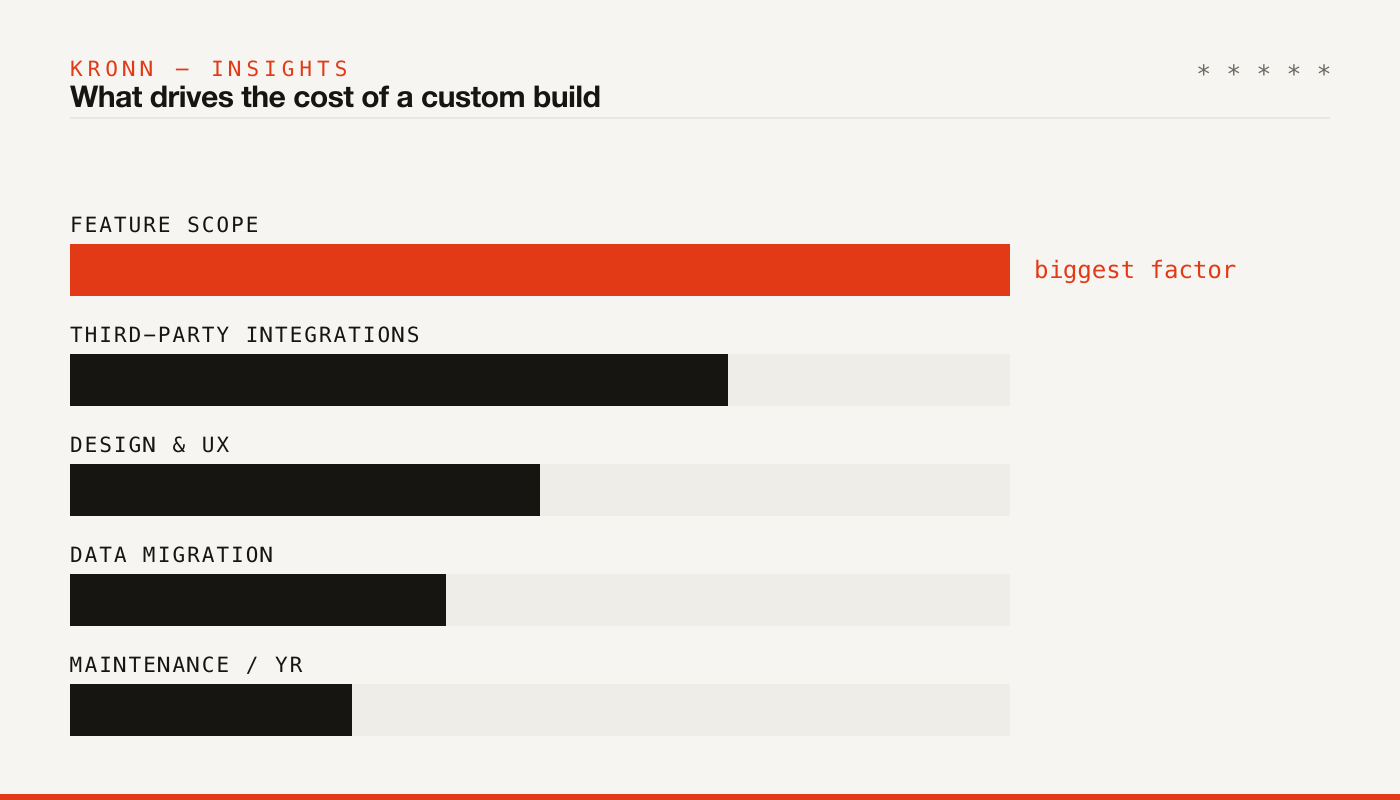
The five factors that move the number
Feature scope is by far the biggest. “Order management” can mean a list with a status field, or a flow with approvals, notifications, partial deliveries and an audit trail. The first is a week; the second, months. That’s why two quotes for “the same” project differ by 3x — they aren’t pricing the same thing.
Integrations. Every connection to a third-party system — ERP, courier, bank, tax platform — adds work that never shows on screen: API quirks, error handling, synchronisation.
Design. A tool for five expert users needs less design investment than a consumer store where every detail moves sales.
Data migration. If today’s data lives in spreadsheets and legacy systems, cleaning and moving it is real, billable work.
Maintenance. Software in production needs care: updates, backups, small fixes, evolution. Budget 15–20% of the build cost annually — and treat it as insurance, not expense.
How the budget stays predictable
Our answer is phased delivery:
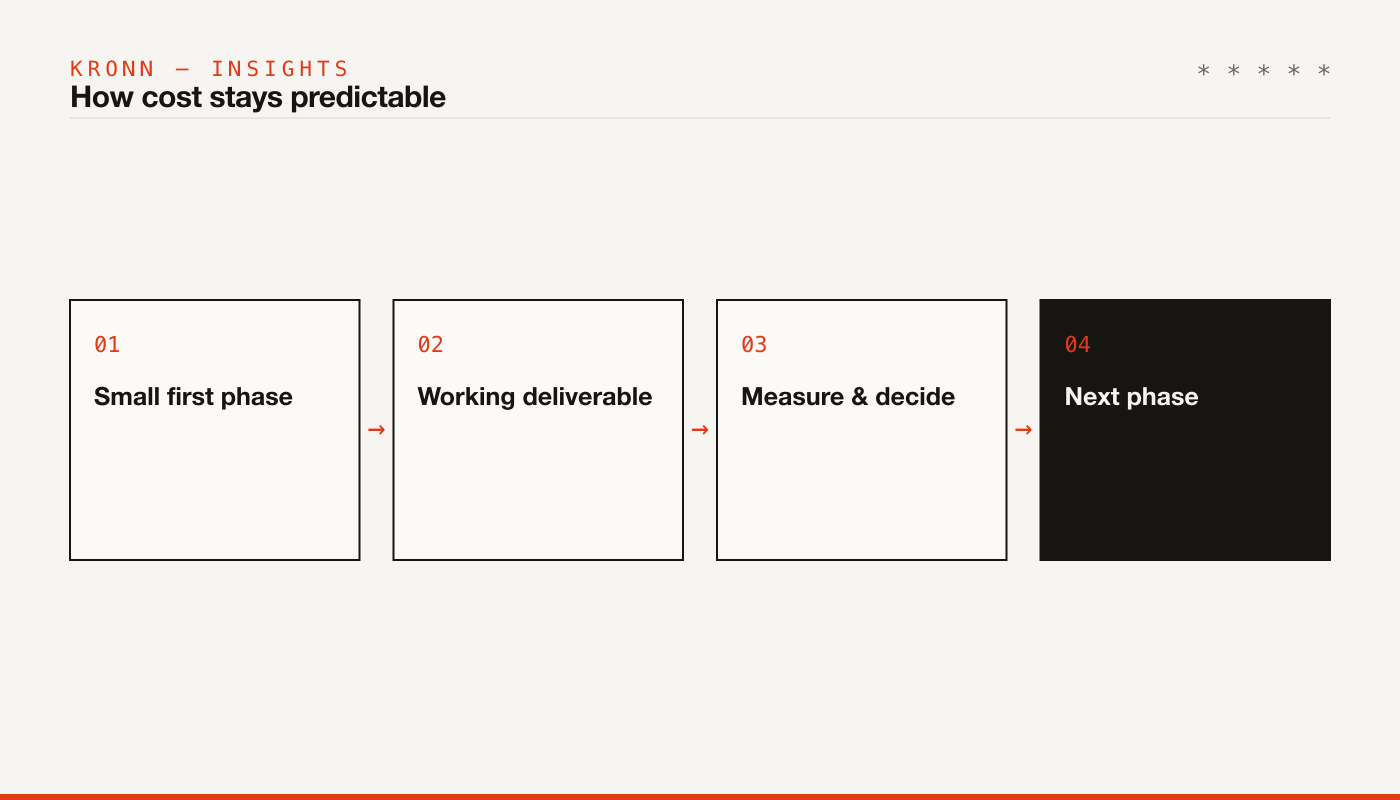
Instead of one mammoth contract, a small first phase with a strict perimeter: the most valuable 20% of the functionality, in production, within 4–8 weeks. The result is measured, and the next phase is decided on real data — not six-month-old assumptions. Every phase has a known cost before it starts; total risk never exceeds the phase that’s running.
This also protects you from the field’s most expensive mistake: building in full something that wasn’t needed in full. At the first working deliverable, half of the “essential” features turn out unnecessary — and that’s money never spent.
What about the “cheap” quote?
There is always an offer at half the price. It usually means one of three things: less scope (fine — if you know it), low-cost subcontractors (you’ll meet the consequences at maintenance time), or a bait price with changes billed steeply afterwards (the most common). Ask what is not included — that’s where the answer hides.
If you want an honest estimate for a specific need, describe your operation to us — we’ll also tell you what not to build. See how we work on custom internal tooling.